Can You Actually Build a Barndominium in Greene County?

HomesFarmsAndLand
Author
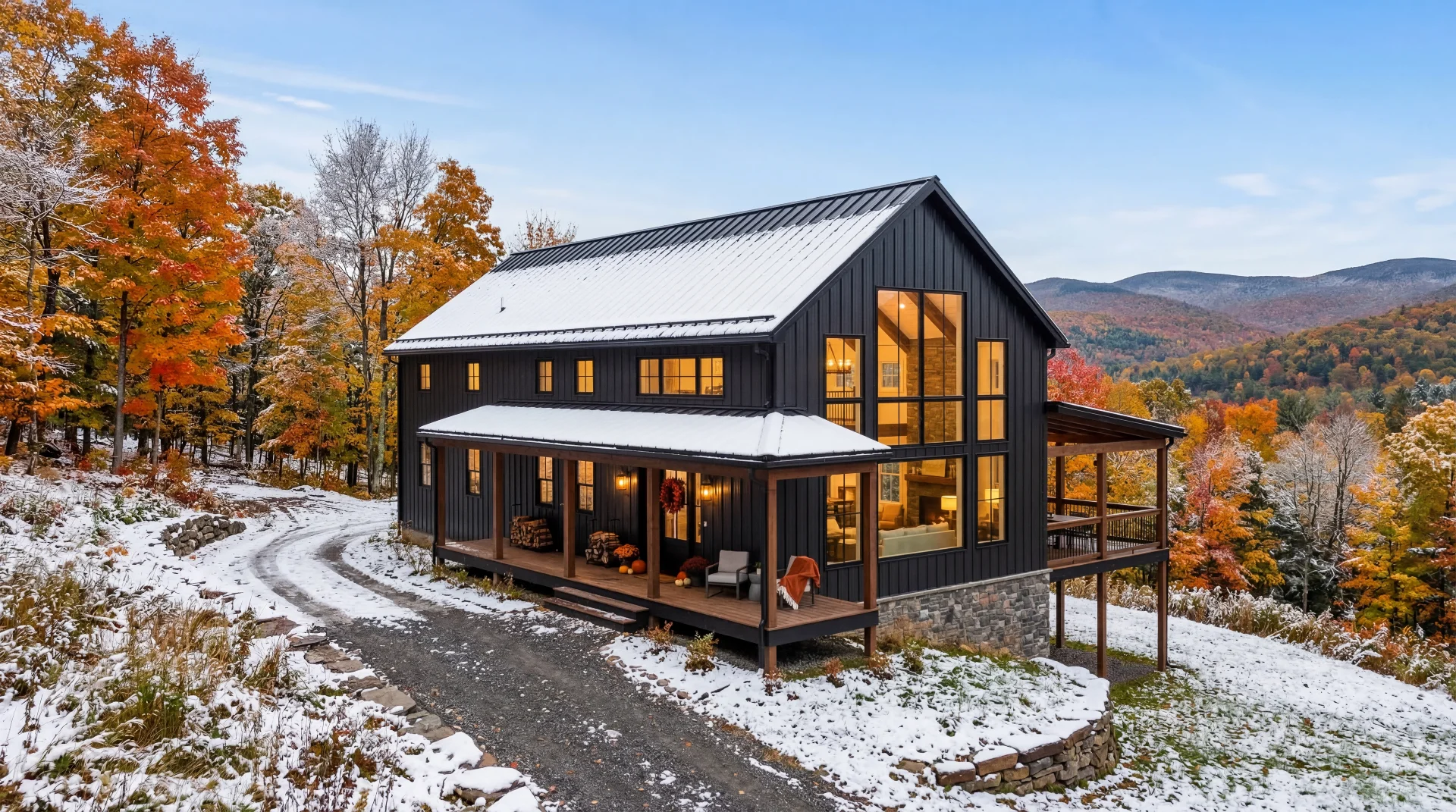
Can You Actually Build a Barndominium in Greene County? A 2026 Zoning & Build Guide
The Most Searched Home Style in America — and What It Actually Takes to Build One Here
Scroll through Instagram, TikTok, or Pinterest long enough and you'll find them everywhere: soaring ceilings, concrete floors, black steel windows, and a clean modern aesthetic that somehow feels both industrial and warm. The barndominium has gone from Texas trend to national obsession — and for good reason.
At their best, barndominiums offer more square footage per dollar than traditional wood-framed construction, faster build timelines, and a design freedom that conventional homes rarely allow. If you're eyeing land in Greene, Otsego, or Delaware County and wondering whether you can pull this off in Upstate New York — the short answer is yes.
But "yes" comes with real conditions. The Catskills aren't the Texas Hill Country. The winters are different, the zoning landscape is fragmented, and the lending environment has its own quirks. Here's exactly what you need to know before you buy land with a barndominium in mind.
What Is a Barndominium? (A Quick Definition for New Buyers)
A barndominium is a steel or metal-frame structure — originally agricultural in form — converted or purpose-built as a residential living space. They typically feature open floor plans, high ceilings, large garage bays or workshop space, and a mix of raw and finished interior materials. Cost-per-square-foot for the shell is often lower than traditional stick-built construction, though finishing costs vary widely depending on interior choices.
They are not modular homes. They are not prefabs. And in New York State, they are treated like any other residential structure from a permitting perspective — which is both a challenge and an opportunity.
Challenge #1: Zoning Is King — and Highly Localized
New York State does not have a single, unified zoning code for rural areas. Zoning authority rests almost entirely with individual towns and villages — and in the Catskills region, that means a patchwork of local laws that can vary dramatically from one township to the next.
In many rural towns throughout Chenango, Otsego, and Delaware Counties, zoning is minimal or non-existent for agricultural and residential structures on large parcels. A metal-frame barndominium on 20 acres outside of Norwich or near Oneonta may face no resistance at all.
But in parts of Greene County — particularly in towns with historic district overlays or scenic corridor regulations — local architectural review boards may require specific siding materials, roof pitches, or setbacks that don't align with a standard metal building design. Some towns near the Catskill Park boundary also have additional environmental review requirements.
The rule before you buy any land: Contact the town clerk or code enforcement officer directly and ask whether a metal-frame residential structure is permitted under current zoning. Make your purchase contract contingent on receiving written confirmation that your build type is allowed. Your agent should be helping you navigate this — if they're not, call us.
Challenge #2: Engineering for a Real Upstate Winter
A barndominium designed for use in Tennessee or Oklahoma will not survive a Schoharie County winter without significant modifications. This isn't a scare tactic — it's structural reality.
Steel frames expand and contract with temperature fluctuations. Snow loads in the Catskills and Central NY can be substantial, particularly at elevation. Any metal building used as a primary residence in New York must be engineered specifically for local snow load and wind requirements — this is not optional, and it is not something a standard metal building kit accounts for by default.
Beyond the structural frame, insulation is the other non-negotiable. Spray foam insulation — both open and closed cell, applied correctly — is the only reliable way to prevent condensation from forming on interior metal panels during deep winter cold snaps. Fiberglass batts, which work fine in traditional framing, are not sufficient in a metal building envelope. Budget for spray foam from the start.
A qualified local structural engineer who has worked with metal buildings in the Northeast is worth every dollar. Their stamp on your drawings is also what gets your permit approved.
Challenge #3: The Financing Hurdle Is Real — But Solvable
Traditional banks and mortgage lenders have been slow to embrace barndominiums, and the reason is purely practical: they rely on comparable sales data to determine appraised value, and there simply aren't enough comparable barndominium sales in most Upstate NY markets to give a conventional lender confidence.
This means a standard construction-to-permanent loan through a major bank may be difficult to secure — especially if the appraiser has no local comps to work from.
The good news is that agricultural lenders and rural-focused credit unions operate by a different framework. Institutions like Farm Credit East and local community banks with agricultural lending portfolios are experienced with non-traditional builds on rural land. They understand the value of a well-built metal structure on acreage and don't require the same comp-heavy appraisal process.
If you're financing a barndominium in Upstate New York, start with agricultural lending sources, not conventional banks. Your agent should be able to connect you with lenders who've closed loans on builds like this in the region.
So — Can You Build One Here?
Yes. Absolutely. And when it's done right, a barndominium, set against the backdrop of the Catskill Mountains or overlooking a Delaware County valley, is genuinely spectacular.
The buyers who succeed with this approach share a few things in common: they find the right piece of land in the right township, they engage a local structural engineer early, they build in the right insulation system, and they work with a lender who actually understands rural construction.
The buyers who struggle are the ones who fall in love with a parcel without doing the zoning homework first — or who try to transplant a southern barndo design directly into a New York winter without modification.
We've helped clients navigate both sides of this. The wins are worth it.
Ready to Find the Right Piece of Land for Your Build?
At HomesFarmsAndLand.com, we don't just find you acreage — we help you find land that actually works for your project. We know which townships are builder-friendly, which parcels have soil and topography suited for construction, and how to structure an offer that protects you through due diligence.
If you're serious about a barndominium build in Upstate New York, the first conversation costs nothing.
👉 Browse Land Listings: homesfarmsandland.com 📞 Talk to a Land Specialist: homesfarmsandland.com/contact ⭐ Read Our Reviews: Google Business Page
Tagged
Keep Reading
Hand-picked articles you might enjoy next.
 Land & Building
What to Know Before Buying Country Property in Upstate NY
Zoning, septic, wells and legal road access decide whether Upstate NY land works. The checklist for Otsego, Delaware and Schoharie county buyers.
 Featured Properties
18.5 Acres in Fort Plain NY With the Farm Already Built
Greenhouse, barn, farm stand and a furnished tiny home on 18.5 acres in Fort Plain, Montgomery County NY. $899,000. Open house Sun, Oct 25, 11 to 2.
 Market Updates
What the Upstate NY Market Is Actually Doing Right Now
Real August 2026 numbers for Schoharie & Otsego County NY: inventory, prices, rates, and what they mean for buyers and sellers this fall.